Tuesday, February 8, 2011

Wednesday 9 February A White Heron


In class reading of Sarah Orne Jewett's A White Heron. See story below, if you are absent.
ALso find the short story vocabulary list you were handed in class. There will be a matching quiz on these words on Monday 14 February.
A WHITE HERON. Sarah Orne Jewett
I. The woods were already filled with shadows one June evening, just before eight o'clock, though a bright sunset still glimmered faintly among the trunks of the trees. A little girl was driving home her cow, a plodding, dilatory, provoking creature in her behavior, but a valued companion for all that. They were going away from whatever light there was, and striking deep into the woods, but their feet were familiar with the path, and it was no matter whether their eyes could see it or not.
There was hardly a night the summer through when the old cow could be found waiting at the pasture bars; on the contrary, it was her greatest pleasure to hide herself away among the huckleberry bushes, and though she wore a loud bell she had made the discovery that if one stood perfectly still it would not ring. So Sylvia had to hunt for her until she found her, and call Co' ! Co' ! with never an answering Moo, until her childish patience was quite spent. If the creature had not given good milk and plenty of it, the case would have seemed very different to her owners. Besides, Sylvia had all the time there was, and very little use to make of it. Sometimes in pleasant weather it was a consolation to look upon the cow's pranks as an intelligent attempt to play hide and seek, and as the child had no playmates she lent herself to this amusement with a good deal of zest. Though this chase had been so long that the wary animal herself had given an unusual signal of her whereabouts, Sylvia had only laughed when she came upon Mistress Moolly at the swamp-side, and urged her affectionately homeward with a twig of birch leaves. The old cow was not inclined to wander farther, she even turned in the right direction for once as they left the pasture, and stepped along the road at a good pace. She was quite ready to be milked now, and seldom stopped to browse. Sylvia wondered what her grandmother would say because they were so late. It was a great while since she had left home at half-past five o'clock, but everybody knew the difficulty of making this errand a short one. Mrs. Tilley had chased the hornéd torment too many summer evenings herself to blame any one else for lingering, and was only thankful as she waited that she had Sylvia, nowadays, to give such valuable assistance. The good woman suspected that Sylvia loitered occasionally on her own account; there never was such a child for straying about out-of-doors since the world was made! Everybody said that it was a good change for a little maid who had tried to grow for eight years in a crowded manufacturing town, but, as for Sylvia herself, it seemed as if she never had been alive at all before she came to live at the farm. She thought often with wistful compassion of a wretched geranium that belonged to a town neighbor.
"'Afraid of folks,'" old Mrs. Tilley said to herself, with a smile, after she had made the unlikely choice of Sylvia from her daughter's houseful of children, and was returning to the farm. "'Afraid of folks,' they said! I guess she won't be troubled no great with 'em up to the old place!" When they reached the door of the lonely house and stopped to unlock it, and the cat came to purr loudly, and rub against them, a deserted pussy, indeed, but fat with young robins, Sylvia whispered that this was a beautiful place to live in, and she never should wish to go home.
The companions followed the shady wood-road, the cow taking slow steps and the child very fast ones. The cow stopped long at the brook to drink, as if the pasture were not half a swamp, and Sylvia stood still and waited, letting her bare feet cool themselves in the shoal water, while the great twilight moths struck softly against her. She waded on through the brook as the cow moved away, and listened to the thrushes with a heart that beat fast with pleasure. There was a stirring in the great boughs overhead. They were full of little birds and beasts that seemed to be wide awake, and going about their world, or else saying good-night to each other in sleepy twitters. Sylvia herself felt sleepy as she walked along. However, it was not much farther to the house, and the air was soft and sweet. She was not often in the woods so late as this, and it made her feel as if she were a part of the gray shadows and the moving leaves. She was just thinking how long it seemed since she first came to the farm a year ago, and wondering if everything went on in the noisy town just the same as when she was there, the thought of the great red-faced boy who used to chase and frighten her made her hurry along the path to escape from the shadow of the trees.
Suddenly this little woods-girl is horror-stricken to hear a clear whistle not very far away. Not a bird's-whistle, which would have a sort of friendliness, but a boy's whistle, determined, and somewhat aggressive. Sylvia left the cow to whatever sad fate might await her, and stepped discreetly aside into the bushes, but she was just too late. The enemy had discovered her, and called out in a very cheerful and persuasive tone, "Halloa, little girl, how far is it to the road?" and trembling Sylvia answered almost inaudibly, "A good ways."
She did not dare to look boldly at the tall young man, who carried a gun over his shoulder, but she came out of her bush and again followed the cow, while he walked alongside.
"I have been hunting for some birds," the stranger said kindly, "and I have lost my way, and need a friend very much. Don't be afraid," he added gallantly. "Speak up and tell me what your name is, and whether you think I can spend the night at your house, and go out gunning early in the morning."
Sylvia was more alarmed than before. Would not her grandmother consider her much to blame? But who could have foreseen such an accident as this? It did not seem to be her fault, and she hung her head as if the stem of it were broken, but managed to answer "Sylvy," with much effort when her companion again asked her name.
Mrs. Tilley was standing in the doorway when the trio came into view. The cow gave a loud moo by way of explanation.
"Yes, you'd better speak up for yourself, you old trial! Where'd she tucked herself away this time, Sylvy?" But Sylvia kept an awed silence; she knew by instinct that her grandmother did not comprehend the gravity of the situation. She must be mistaking the stranger for one of the farmer-lads of the region.
The young man stood his gun beside the door, and dropped a lumpy game-bag beside it; then he bade Mrs. Tilley good-evening, and repeated his wayfarer's story, and asked if he could have a night's lodging.
"Put me anywhere you like," he said. "I must be off early in the morning, before day; but I am very hungry, indeed. You can give me some milk at any rate, that's plain."
"Dear sakes, yes," responded the hostess, whose long slumbering hospitality seemed to be easily awakened. "You might fare better if you went out to the main road a mile or so, but you're welcome to what we've got. I'll milk right off, and you make yourself at home. You can sleep on husks or feathers," she proffered graciously. "I raised them all myself. There's good pasturing for geese just below here towards the ma'sh. Now step round and set a plate for the gentleman, Sylvy!" And Sylvia promptly stepped. She was glad to have something to do, and she was hungry herself.
It was a surprise to find so clean and comfortable a little dwelling in this New England wilderness. The young man had known the horrors of its most primitive housekeeping, and the dreary squalor of that level of society which does not rebel at the companionship of hens. This was the best thrift of an old-fashioned farmstead, though on such a small scale that it seemed like a hermitage. He listened eagerly to the old woman's quaint talk, he watched Sylvia's pale face and shining gray eyes with ever growing enthusiasm, and insisted that this was the best supper he had eaten for a month, and afterward the new-made friends sat down in the door-way together while the moon came up.
Soon it would be berry-time, and Sylvia was a great help at picking. The cow was a good milker, though a plaguy thing to keep track of, the hostess gossiped frankly, adding presently that she had buried four children, so Sylvia's mother, and a son (who might be dead) in California were all the children she had left. "Dan, my boy, was a great hand to go gunning," she explained sadly. "I never wanted for pa'tridges or gray squer'ls while he was to home. He's been a great wand'rer, I expect, and he's no hand to write letters. There, I don't blame him, I'd ha' seen the world myself if it had been so I could.

"Sylvy takes after him," the grandmother continued affectionately, after a minute's pause. "There ain't a foot o' ground she don't know her way over, and the wild creaturs counts her one o' themselves. Squer'ls she'll tame to come an' feed right out o' her hands, and all sorts o' birds. Last winter she got the jay-birds to bangeing here, and I believe she'd 'a' scanted herself of her own meals to have plenty to throw out amongst 'em, if I hadn't kep' watch. Anything but crows, I tell her, I'm willin' to help support -- though Dan he had a tamed one o' them that did seem to have reason same as folks. It was round here a good spell after he went away. Dan an' his father they didn't hitch, -- but he never held up his head ag'in after Dan had dared him an' gone off."
The guest did not notice this hint of family sorrows in his eager interest in something else.
"So Sylvy knows all about birds, does she?" he exclaimed, as he looked round at the little girl who sat, very demure but increasingly sleepy, in the moonlight. "I am making a collection of birds myself. I have been at it ever since I was a boy." (Mrs. Tilley smiled.) "There are two or three very rare ones I have been hunting for these five years. I mean to get them on my own ground if they can be found."
"Do you cage 'em up?" asked Mrs. Tilley doubtfully, in response to this enthusiastic announcement.

"Oh no, they're stuffed and preserved, dozens and dozens of them," said the ornithologist, "and I have shot or snared every one myself. I caught a glimpse of a white heron a few miles from here on Saturday, and I have followed it in this direction. They have never been found in this district at all. The little white heron, it is," and he turned again to look at Sylvia with the hope of discovering that the rare bird was one of her acquaintances.
But Sylvia was watching a hop-toad in the narrow footpath.
"You would know the heron if you saw it," the stranger continued eagerly. "A queer tall white bird with soft feathers and long thin legs. And it would have a nest perhaps in the top of a high tree, made of sticks, something like a hawk's nest."
Sylvia's heart gave a wild beat; she knew that strange white bird, and had once stolen softly near where it stood in some bright green swamp grass, away over at the other side of the woods. There was an open place where the sunshine always seemed strangely yellow and hot, where tall, nodding rushes grew, and her grandmother had warned her that she might sink in the soft black mud underneath and never be heard of more. Not far beyond were the salt marshes just this side the sea itself, which Sylvia wondered and dreamed much about, but never had seen, whose great voice could sometimes be heard above the noise of the woods on stormy nights.
"I can't think of anything I should like so much as to find that heron's nest," the handsome stranger was saying. "I would give ten dollars to anybody who could show it to me," he added desperately, "and I mean to spend my whole vacation hunting for it if need be. Perhaps it was only migrating, or had been chased out of its own region by some bird of prey."
Mrs. Tilley gave amazed attention to all this, but Sylvia still watched the toad, not divining, as she might have done at some calmer time, that the creature wished to get to its hole under the door-step, and was much hindered by the unusual spectators at that hour of the evening. No amount of thought, that night, could decide how many wished-for treasures the ten dollars, so lightly spoken of, would buy.


The next day the young sportsman hovered about the woods, and Sylvia kept him company, having lost her first fear of the friendly lad, who proved to be most kind and sympathetic. He told her many things about the birds and what they knew and where they lived and what they did with themselves. And he gave her a jack-knife, which she thought as great a treasure as if she were a desert-islander. All day long he did not once make her troubled or afraid except when he brought down some unsuspecting singing creature from its bough. Sylvia would have liked him vastly better without his gun; she could not understand why he killed the very birds he seemed to like so much. But as the day waned, Sylvia still watched the young man with loving admiration. She had never seen anybody so charming and delightful; the woman's heart, asleep in the child, was vaguely thrilled by a dream of love. Some premonition of that great power stirred and swayed these young creatures who traversed the solemn woodlands with soft-footed silent care. They stopped to listen to a bird's song; they pressed forward again eagerly, parting the branches -- speaking to each other rarely and in whispers; the young man going first and Sylvia following, fascinated, a few steps behind, with her gray eyes dark with excitement.
She grieved because the longed-for white heron was elusive, but she did not lead the guest, she only followed, and there was no such thing as speaking first. The sound of her own unquestioned voice would have terrified her -- it was hard enough to answer yes or no when there was need of that. At last evening began to fall, and they drove the cow home together, and Sylvia smiled with pleasure when they came to the place where she heard the whistle and was afraid only the night before.
II. Half a mile from home, at the farther edge of the woods, where the land was highest, a great pine-tree stood, the last of its generation. Whether it was left for a boundary mark, or for what reason, no one could say; the woodchoppers who had felled its mates were dead and gone long ago, and a whole forest of sturdy trees, pines and oaks and maples, had grown again. But the stately head of this old pine towered above them all and made a landmark for sea and shore miles and miles away. Sylvia knew it well. She had always believed that whoever climbed to the top of it could see the ocean; and the little girl had often laid her hand on the great rough trunk and looked up wistfully at those dark boughs that the wind always stirred, no matter how hot and still the air might be below. Now she thought of the tree with a new excitement, for why, if one climbed it at break of day, could not one see all the world, and easily discover from whence the white heron flew, and mark the place, and find the hidden nest?
What a spirit of adventure, what wild ambition! What fancied triumph and delight and glory for the later morning when she could make known the secret! It was almost too real and too great for the childish heart to bear.
All night the door of the little house stood open and the whippoorwills came and sang upon the very step. The young sportsman and his old hostess were sound asleep, but Sylvia's great design kept her broad awake and watching. She forgot to think of sleep. The short summer night seemed as long as the winter darkness, and at last when the whippoorwills ceased, and she was afraid the morning would after all come too soon, she stole out of the house and followed the pasture path through the woods, hastening toward the open ground beyond, listening with a sense of comfort and companionship to the drowsy twitter of a half-awakened bird, whose perch she had jarred in passing. Alas, if the great wave of human interest which flooded for the first time this dull little life should sweep away the satisfactions of an existence heart to heart with nature and the dumb life of the forest!
There was the huge tree asleep yet in the paling moonlight, and small and silly Sylvia began with utmost bravery to mount to the top of it, with tingling, eager blood coursing the channels of her whole frame, with her bare feet and fingers, that pinched and held like bird's claws to the monstrous ladder reaching up, up, almost to the sky itself. First she must mount the white oak tree that grew alongside, where she was almost lost among the dark branches and the green leaves heavy and wet with dew; a bird fluttered off its nest, and a red squirrel ran to and fro and scolded pettishly at the harmless housebreaker. Sylvia felt her way easily. She had often climbed there, and knew that higher still one of the oak's upper branches chafed against the pine trunk, just where its lower boughs were set close together. There, when she made the dangerous pass from one tree to the other, the great enterprise would really begin.
She crept out along the swaying oak limb at last, and took the daring step across into the old pine-tree. The way was harder than she thought; she must reach far and hold fast, the sharp dry twigs caught and held her and scratched her like angry talons, the pitch made her thin little fingers clumsy and stiff as she went round and round the tree's great stem, higher and higher upward. The sparrows and robins in the woods below were beginning to wake and twitter to the dawn, yet it seemed much lighter there aloft in the pine-tree, and the child knew she must hurry if her project were to be of any use.
The tree seemed to lengthen itself out as she went up, and to reach farther and farther upward. It was like a great main-mast to the voyaging earth; it must truly have been amazed that morning through all its ponderous frame as it felt this determined spark of human spirit wending its way from higher branch to branch. Who knows how steadily the least twigs held themselves to advantage this light, weak creature on her way! The old pine must have loved his new dependent. More than all the hawks, and bats, and moths, and even the sweet voiced thrushes, was the brave, beating heart of the solitary gray-eyed child. And the tree stood still and frowned away the winds that June morning while the dawn grew bright in the east.
Sylvia's face was like a pale star, if one had seen it from the ground, when the last thorny bough was past, and she stood trembling and tired but wholly triumphant, high in the tree-top. Yes, there was the sea with the dawning sun making a golden dazzle over it, and toward that glorious east flew two hawks with slow-moving pinions. How low they looked in the air from that height when one had only seen them before far up, and dark against the blue sky. Their gray feathers were as soft as moths; they seemed only a little way from the tree, and Sylvia felt as if she too could go flying away among the clouds. Westward, the woodlands and farms reached miles and miles into the distance; here and there were church steeples, and white villages, truly it was a vast and awesome world
The birds sang louder and louder. At last the sun came up bewilderingly bright. Sylvia could see the white sails of ships out at sea, and the clouds that were purple and rose-colored and yellow at first began to fade away. Where was the white heron's nest in the sea of green branches, and was this wonderful sight and pageant of the world the only reward for having climbed to such a giddy height? Now look down again, Sylvia, where the green marsh is set among the shining birches and dark hemlocks; there where you saw the white heron once you will see him again; look, look! a white spot of him like a single floating feather comes up from the dead hemlock and grows larger, and rises, and comes close at last, and goes by the landmark pine with steady sweep of wing and outstretched slender neck and crested head. And wait! wait! do not move a foot or a finger, little girl, do not send an arrow of light and consciousness from your two eager eyes, for the heron has perched on a pine bough not far beyond yours, and cries back to his mate on the nest and plumes his feathers for the new day!
The child gives a long sigh a minute later when a company of shouting cat-birds comes also to the tree, and vexed by their fluttering and lawlessness the solemn heron goes away. She knows his secret now, the wild, light, slender bird that floats and wavers, and goes back like an arrow presently to his home in the green world beneath. Then Sylvia, well satisfied, makes her perilous way down again, not daring to look far below the branch she stands on, ready to cry sometimes because her fingers ache and her lamed feet slip. Wondering over and over again what the stranger would say to her, and what he would think when she told him how to find his way straight to the heron's nest.

"Sylvy, Sylvy!" called the busy old grandmother again and again, but nobody answered, and the small husk bed was empty and Sylvia had disappeared.
The guest waked from a dream, and remembering his day's pleasure hurried to dress himself that it might sooner begin. He was sure from the way the shy little girl looked once or twice yesterday that she had at least seen the white heron, and now she must really be made to tell. Here she comes now, paler than ever, and her worn old frock is torn and tattered, and smeared with pine pitch. The grandmother and the sportsman stand in the door together and question her, and the splendid moment has come to speak of the dead hemlock-tree by the green marsh.
But Sylvia does not speak after all, though the old grandmother fretfully rebukes her, and the young man's kind, appealing eyes are looking straight in her own. He can make them rich with money; he has promised it, and they are poor now. He is so well worth making happy, and he waits to hear the story she can tell.
No, she must keep silence! What is it that suddenly forbids her and makes her dumb? Has she been nine years growing and now, when the great world for the first time puts out a hand to her, must she thrust it aside for a bird's sake? The murmur of the pine's green branches is in her ears, she remembers how the white heron came flying through the golden air and how they watched the sea and the morning together, and Sylvia cannot speak; she cannot tell the heron's secret and give its life away.
Dear loyalty, that suffered a sharp pang as the guest went away disappointed later in the day, that could have served and followed him and loved him as a dog loves! Many a night Sylvia heard the echo of his whistle haunting the pasture path as she came home with the loitering cow. She forgot even her sorrow at the sharp report of his gun and the sight of thrushes and sparrows dropping silent to the ground, their songs hushed and their pretty feathers stained and wet with blood. Were the birds better friends than their hunter might have been, -- who can tell? Whatever treasures were lost to her, woodlands and summer-time, remember! Bring your gifts and graces and tell your secrets to this lonely country child!

Sunday, February 6, 2011

Tuesday February 8 The Outcasts of Poker Flats


In class writing on The Outcasts of Poker Flat

What inferences about the attitudes and customs of the people of Poker Flat can you make from the following passages? Write one paragraph that reflects both.
a. A few of the committee had urged hanging him as a possible example, and a sure method of reimbursing themselves from his pocket of the sums he had won from them."
b. " 'It's a fine justice,' said Jim Wheeler, 'to let this yer young man-an entire stranger-carry away our money.' "


Write a second paragraph on the following:
Though the characters in this story have little in common, they band together in support of one another. What draws these people together? (Make sure to use details: names, ages, occupations, and vividness of the setting.) Now look deeper. What type of situations tend to draw people together in real life? Why?

Monday 7 February Occurence at Owl Creek


Due today: vocabulary 9 and the responses accompanying Owl Creek. Those not turning them in at the beginning of class should plan on be sent out to complete them, while the rest of us watch the Twilight Zone version of this short story.
In class viewing of Ambrose Bierce's An Occurence At Owl Creek Bridge.
Note the literary qualities of realism: the harsh, pessimistic view of life, how circumstances beyond our contol determine how our lives are lived. These are portrayed both in the short story and the film.
HOMEWORK: Please read Bret Harte's The Outcasts of Poker Flat. There is a copy below, if you misplace the class handout. Note that this is regional literature; it captures the distinctive atmosphere or "local color,' of a particular area by accurately depicting the habits, speech, appearance, customs, and beliefs of its people and vividly describing its appearance. Be prepared to write Tuesday on the following:
What inferences about the attitudes and customs of he people of Poker Flat can you make from each of the following passages?
1. A few of the committee had urged hanging him as a possible example, and a sure method of reimbursin themselves from his pocket of the sums he had won from them."
2. " 'It's a fine justice,' said Jim Wheeeler, 'to let this yer young man-an entire stranger-cary away our money.' "


The Outcasts of Poker Flat by Bret Hart.
As Mr. John Oakhurst, gambler, stepped into the main street of Poker Flat on the morning of the twenty-third of November, 1850, he was conscious of a change in its moral atmosphere since the preceding night. Two or three men, conversing earnestly together, ceased as he approached, and exchanged significant glances. There was a Sabbath lull in the air which, in a settlement unused to Sabbath influences, looked ominous.
Mr. Oakhurst's calm, handsome face betrayed small concern in these indications. Whether he was conscious of any predisposing cause was another question. "I reckon they're after somebody," he reflected; "likely it's me." He returned to his pocket the handkerchief with which he had been whipping away the red dust of Poker Flat from his neat boots, and quietly discharged his mind of any further conjecture.
In point of fact, Poker Flat was "after somebody." It had lately suffered the loss of several thousand dollars, two valuable horses, and a prominent citizen. It was experiencing a spasm of virtuous reaction, quite as lawless and ungovernable as any of the acts that had provoked it. A secret committee had determined to rid the town of all improper persons. This was done permanently in regard of two men who were then hanging from the boughs of a sycamore in the gulch, and temporarily in the banishment of certain other objectionable characters. I regret to say that some of these were ladies. It is but due to the sex, however, to state that their impropriety was professional, and it was only in such easily established standards of evil that Poker Flat ventured to sit in judgment.
Mr. Oakhurst was right in supposing that he was included in this category. A few of the committee had urged hanging him as a possible example, and a sure method of reimbursing themselves from his pockets of the sums he had won from them. "It's agin justice," said Jim Wheeler, "to let this yer young man from Roaring Camp--an entire stranger--carry away our money." But a crude sentiment of equity residing in the breasts of those who had been fortunate enough to win from Mr. Oakhurst overruled this narrower local prejudice.
Mr. Oakhurst received his sentence with philosophic calmness, none the less coolly that he was aware of the hesitation of his judges. He was too much of a gambler not to accept Fate. With him life was at best an uncertain game, and he recognized the usual percentage in favor of the dealer.
A body of armed men accompanied the deported wickedness of Poker Flat to the outskirts of the settlement. Besides Mr. Oakhurst, who was known to be a coolly desperate man, and for whose intimidation the armed escort was intended, the expatriated party consisted of a young woman familiarly known as the "Duchess"; another, who had won the title of "Mother Shipton"; and "Uncle Billy," a suspected sluice-robber and confirmed drunkard. The cavalcade provoked no comments from the spectators, nor was any word uttered by the escort. Only, when the gulch which marked the uttermost limit of Poker Flat was reached, the leader spoke briefly and to the point. The exiles were forbidden to return at the peril of their lives.
As the escort disappeared, their pent-up feelings found vent in a few hysterical tears from the Duchess, some bad language from Mother Shipton, and a Parthian volley of expletives from Uncle Billy. The philosophic Oakhurst alone remained silent. He listened calmly to Mother Shipton's desire to cut somebody's heart out, to the repeated statements of the Duchess that she would die in the road, and to the alarming oaths that seemed to be bumped out of Uncle Billy as he rode forward. With the easy good humor characteristic of his class, he insisted upon exchanging his own riding horse, "Five Spot," for the sorry mule which the Duchess rode. But even this act did not draw the party into any closer sympathy. The young woman readjusted her somewhat draggled plumes with a feeble, faded coquetry; Mother Shipton eyed the possessor of "Five Spot" with malevolence, and Uncle Billy included the whole party in one sweeping anathema.

The road to Sandy Bar--a camp that, not having as yet experienced the regenerating influences of Poker Flat, consequently seemed to offer some invitation to the emigrants--lay over a steep mountain range. It was distant a day's severe travel. In that advanced season, the party soon passed out of the moist, temperate regions of the foothills into the dry, cold, bracing air of the Sierras. The trail was narrow and difficult. At noon the Duchess, rolling out of her saddle upon the ground, declared her intention of going no farther, and the party halted.
The spot was singularly wild and impressive. A wooded amphitheater, surrounded on three sides by precipitous cliffs of naked granite, sloped gently toward the crest of another precipice that overlooked the valley. It was, undoubtedly, the most suitable spot for a camp, had camping been advisable. But Mr. Oakhurst knew that scarcely half the journey to Sandy Bar was accomplished, and the party were not equipped or provisioned for delay. This fact he pointed out to his companions curtly, with a philosophic commentary on the folly of "throwing up their hand before the game was played out." But they were furnished with liquor, which in this emergency stood them in place of food, fuel, rest, and prescience. In spite of his remonstrances, it was not long before they were more or less under its influence. Uncle Billy passed rapidly from a bellicose state into one of stupor, the Duchess became maudlin, and Mother Shipton snored. Mr. Oakhurst alone remained erect, leaning against a rock, calmly surveying them.
Mr. Oakhurst did not drink. It interfered with a profession which required coolness, impassiveness, and presence of mind, and, in his own language, he "couldn't afford it." As he gazed at his recumbent fellow exiles, the loneliness begotten of his pariah trade, his habits of life, his very vices, for the first time seriously oppressed him. He bestirred himself in dusting his black clothes, washing his hands and face, and other acts characteristic of his studiously neat habits, and for a moment forgot his annoyance. The thought of deserting his weaker and more pitiable companions never perhaps occurred to him. Yet he could not help feeling the want of that excitement which, singularly enough, was most conducive to that calm equanimity for which he was notorious. He looked at the gloomy walls that rose a thousand feet sheer above the circling pines around him; at the sky, ominously clouded; at the valley below, already deepening into shadow. And, doing so, suddenly he heard his own name called.
A horseman slowly ascended the trail. In the fresh, open face of the newcomer Mr. Oakhurst recognized Tom Simson, otherwise known as the "Innocent" of Sandy Bar. He had met him some months before over a "little game," and had, with perfect equanimity, won the entire fortune--amounting to some forty dollars--of that guileless youth. After the game was finished, Mr. Oakhurst drew the youthful speculator behind the door and thus addressed him: "Tommy, you're a good little man, but you can't gamble worth a cent. Don't try it over again." He then handed him his money back, pushed him gently from the room, and so made a devoted slave of Tom Simson.
There was a remembrance of this in his boyish and enthusiastic greeting of Mr. Oakhurst. He had started, he said, to go to Poker Flat to seek his fortune. "Alone?" No, not exactly alone; in fact (a giggle), he had run away with Piney Woods. Didn't Mr. Oakhurst remember Piney? She that used to wait on the table at the Temperance House? They had been engaged a long time, but old Jake Woods had objected, and so they had run away, and were going to Poker Flat to be married, and here they were. And they were tired out, and how lucky it was they had found a place to camp and company. All this the Innocent delivered rapidly, while Piney, a stout, comely damsel of fifteen, emerged from behind the pine tree, where she had been blushing unseen, and rode to the side of her lover.
Mr. Oakhurst seldom troubled himself with sentiment, still less with propriety; but he had a vague idea that the situation was not fortunate. He retained, however, his presence of mind sufficiently to kick Uncle Billy, who was about to say something, and Uncle Billy was sober enough to recognize in Mr. Oakhurst's kick a superior power that would not bear trifling. He then endeavored to dissuade Tom Simson from delaying further, but in vain. He even pointed out the fact that there was no provision, nor means of making a camp. But, unluckily, the Innocent met this objection by assuring the party that he was provided with an extra mule loaded with provisions and by the discovery of a rude attempt at a log house near the trail. "Piney can stay with Mrs. Oakhurst," said the Innocent, pointing to the Duchess, "and I can shift for myself."
Nothing but Mr. Oakhurst's admonishing foot saved Uncle Billy from bursting into a roar of laughter. As it was, he felt compelled to retire up the canyon until he could recover his gravity. There he confided the joke to the tall pine trees, with many slaps of his leg, contortions of his face, and the usual profanity. But when he returned to the party, he found them seated by a fire--for the air had grown strangely chill and the sky overcast--in apparently amicable conversation. Piney was actually talking in an impulsive, girlish fashion to the Duchess, who was listening with an interest and animation she had not shown for many days. The Innocent was holding forth, apparently with equal effect, to Mr. Oakhurst and Mother Shipton, who was actually relaxing into amiability. "Is this yer a damned picnic?" said Uncle Billy with inward scorn as he surveyed the sylvan group, the glancing firelight, and the tethered animals in the foreground. Suddenly an idea mingled with the alcoholic fumes that disturbed his brain. It was apparently of a jocular nature, for he felt impelled to slap his leg again and cram his fist into his mouth.
As the shadows crept slowly up the mountain, a slight breeze rocked the tops of the pine trees, and moaned through their long and gloomy aisles. The ruined cabin, patched and covered with pine boughs, was set apart for the ladies. As the lovers parted, they unaffectedly exchanged a kiss, so honest and sincere that it might have been heard above the swaying pines. The frail Duchess and the malevolent Mother Shipton were probably too stunned to remark upon this last evidence of simplicity, and so turned without a word to the hut. The fire was replenished, the men lay down before the door, and in a few minutes were asleep.
Mr. Oakhurst was a light sleeper. Toward morning he awoke benumbed and cold. As he stirred the dying fire, the wind, which was now blowing strongly, brought to his cheek that which caused the blood to leave it--snow!
He started to his feet with the intention of awakening the sleepers, for there was no time to lose. But turning to where Uncle Billy had been lying, he found him gone. A suspicion leaped to his brain and a curse to his lips. He ran to the spot where the mules had been tethered; they were no longer there. The tracks were already rapidly disappearing in the snow.
The momentary excitement brought Mr. Oakhurst back to the fire with his usual calm. He did not waken the sleepers. The Innocent slumbered peacefully, with a smile on his good-humored, freckled face; the virgin Piney slept beside her frailer sisters as sweetly as though attended by celestial guardians; and Mr. Oakhurst, drawing his blanket over his shoulders, stroked his mustaches and waited for the dawn. It came slowly in a whirling mist of snowflakes that dazzled and confused the eye. What could be seen of the landscape appeared magically changed. He looked over the valley, and summed up the present and future in two words--"snowed in!"
A careful inventory of the provisions, which, fortunately for the party, had been stored within the hut and so escaped the felonious fingers of Uncle Billy, disclosed the fact that with care and prudence they might last ten days longer. "That is," said Mr. Oakhurst, sotto voce to the Innocent, "if you're willing to board us. If you ain't--and perhaps you'd better not--you can wait till Uncle Billy gets back with provisions." For some occult reason, Mr. Oakhurst could not bring himself to disclose Uncle Billy's rascality, and so offered the hypothesis that he had wandered from the camp and had accidentally stampeded the animals. He dropped a warning to the Duchess and Mother Shipton, who of course knew the facts of their associate's defection. "They'll find out the truth about us all when they find out anything," he added, significantly, "and there's no good frightening them now."
Tom Simson not only put all his worldly store at the disposal of Mr. Oakhurst, but seemed to enjoy the prospect of their enforced seclusion. "We'll have a good camp for a week, and then the snow'll melt, and we'll all go back together." The cheerful gaiety of the young man, and Mr. Oakhurst's calm, infected the others. The Innocent with the aid of pine boughs extemporized a thatch for the roofless cabin, and the Duchess directed Piney in the rearrangement of the interior with a taste and tact that opened the blue eyes of that provincial maiden to their fullest extent. "I reckon now you're used to fine things at Poker Flat," said Piney. The Duchess turned away sharply to conceal something that reddened her cheeks through its professional tint, and Mother Shipton requested Piney not to "chatter." But when Mr. Oakhurst returned from a weary search for the trail, he heard the sound of happy laughter echoed from the rocks. He stopped in some alarm, and his thoughts first naturally reverted to the whisky, which he had prudently cached. "And yet it don't somehow sound like whisky," said the gambler. It was not until he caught sight of the blazing fire through the still-blinding storm and the group around it that he settled to the conviction that it was "square fun."
Whether Mr. Oakhurst had cached his cards with the whisky as something debarred the free access of the community, I cannot say. It was certain that, in Mother Shipton's words, he "didn't say cards once" during that evening. Haply the time was beguiled by an accordion, produced somewhat ostentatiously by Tom Simson from his pack. Notwithstanding some difficulties attending the manipulation of this instrument, Piney Woods managed to pluck several reluctant melodies from its keys, to an accompaniment by the Innocent on a pair of bone castanets. But the crowning festivity of the evening was reached in a rude camp-meeting hymn, which the lovers, joining hands, sang with great earnestness and vociferation. I fear that a certain defiant tone and Covenanter's swing to its chorus, rather than any devotional quality, caused it speedily to infect the others, who at last joined in the refrain:
"I'm proud to live in the service of the Lord,
And I'm bound to die in His army."
The pines rocked, the storm eddied and whirled above the miserable group, and the flames of their altar leaped heavenward as if in token of the vow.
At midnight the storm abated, the rolling clouds parted, and the stars glittered keenly above the sleeping camp. Mr. Oakhurst, whose professional habits had enabled him to live on the smallest possible amount of sleep, in dividing the watch with Tom Simson somehow managed to take upon himself the greater part of that duty. He excused himself to the Innocent by saying that he had "often been a week without sleep." "Doing what?" asked Tom. "Poker!" replied Oakhurst, sententiously; "when a man gets a streak of luck,--nigger luck--he don't get tired. The luck gives in first. Luck," continued the gambler, reflectively, "is a mighty queer thing. All you know about it for certain is that it's bound to change. And it's finding out when it's going to change that makes you. We've had a streak of bad luck since we left Poker Flat--you come along, and slap you get into it, too. If you can hold your cards right along you're all right. For," added the gambler, with cheerful irrelevance,
"'I'm proud to live in the service of the Lord,
And I'm bound to die in His army.'"
The third day came, and the sun, looking through the white- curtained valley, saw the outcasts divide their slowly decreasing store of provisions for the morning meal. It was one of the peculiarities of that mountain climate that its rays diffused a kindly warmth over the wintry landscape, as if in regretful commiseration of the past. But it revealed drift on drift of snow piled high around the hut--a hopeless, uncharted, trackless sea of white lying below the rocky shores to which the castaways still clung. Through the marvelously clear air the smoke of the pastoral village of Poker Flat rose miles away. Mother Shipton saw it, and from a remote pinnacle of her rocky fastness hurled in that direction a final malediction. It was her last vituperative attempt, and perhaps for that reason was invested with a certain degree of sublimity. It did her good, she privately informed the Duchess. "Just you go out there and cuss, and see." She then set herself to the task of amusing "the child," as she and the Duchess were pleased to call Piney. Piney was no chicken, but it was a soothing and original theory of the pair thus to account for the fact that she didn't swear and wasn't improper.

When night crept up again through the gorges, the reedy notes of the accordion rose and fell in fitful spasms and long-drawn gasps by the flickering campfire. But music failed to fill entirely the aching void left by insufficient food, and a new diversion was proposed by Piney--storytelling. Neither Mr. Oakhurst nor his female companions caring to relate their personal experiences, this plan would have failed too but for the Innocent. Some months before he had chanced upon a stray copy of Mr. Pope's ingenious translation of the ILIAD. He now proposed to narrate the principal incidents of that poem--having thoroughly mastered the argument and fairly forgotten the words--in the current vernacular of Sandy Bar. And so for the rest of that night the Homeric demigods again walked the earth. Trojan bully and wily Greek wrestled in the winds, and the great pines in the canyon seemed to bow to the wrath of the son of Peleus. Mr. Oakhurst listened with quiet satisfaction. Most especially was he interested in the fate of "Ash-heels," as the Innocent persisted in denominating the "swift-footed Achilles."
So with small food and much of Homer and the accordion, a week passed over the heads of the outcasts. The sun again forsook them, and again from leaden skies the snowflakes were sifted over the land. Day by day closer around them drew the snowy circle, until at last they looked from their prison over drifted walls of dazzling white that towered twenty feet above their heads. It became more and more difficult to replenish their fires, even from the fallen trees beside them, now half-hidden in the drifts. And yet no one complained. The lovers turned from the dreary prospect and looked into each other's eyes, and were happy. Mr. Oakhurst settled himself coolly to the losing game before him. The Duchess, more cheerful than she had been, assumed the care of Piney. Only Mother Shipton--once the strongest of the party--seemed to sicken and fade. At midnight on the tenth day she called Oakhurst to her side. "I'm going," she said, in a voice of querulous weakness, "but don't say anything about it. Don't waken the kids. Take the bundle from under my head and open it." Mr. Oakhurst did so. It contained Mother Shipton's rations for the last week, untouched. "Give 'em to the child," she said, pointing to the sleeping Piney. "You've starved yourself," said the gambler. "That's what they call it," said the woman, querulously, as she lay down again and, turning her face to the wall, passed quietly away.
The accordion and the bones were put aside that day, and Homer was forgotten. When the body of Mother Shipton had been committed to the snow, Mr. Oakhurst took the Innocent aside, and showed him a pair of snowshoes, which he had fashioned from the old pack saddle. "There's one chance in a hundred to save her yet," he said, pointing to Piney; "but it's there," he added, pointing toward Poker Flat. "If you can reach there in two days she's safe." "And you?" asked Tom Simson. "I'll stay here," was the curt reply.
The lovers parted with a long embrace. "You are not going, too?" said the Duchess as she saw Mr. Oakhurst apparently waiting to accompany him. "As far as the canyon," he replied. He turned suddenly, and kissed the Duchess, leaving her pallid face aflame and her trembling limbs rigid with amazement.
Night came, but not Mr. Oakhurst. It brought the storm again and the whirling snow. Then the Duchess, feeding the fire, found that someone had quietly piled beside the hut enough fuel to last a few days longer. The tears rose to her eyes, but she hid them from Piney.
The women slept but little. In the morning, looking into each other's faces, they read their fate. Neither spoke; but Piney, accepting the position of the stronger, drew near and placed her arm around the Duchess's waist. They kept this attitude for the rest of the day. That night the storm reached its greatest fury, and, rending asunder the protecting pines, invaded the very hut.
Toward morning they found themselves unable to feed the fire, which gradually died away. As the embers slowly blackened, the Duchess crept closer to Piney, and broke the silence of many hours: "Piney, can you pray?" "No, dear," said Piney, simply. The Duchess, without knowing exactly why, felt relieved, and, putting her head upon Piney's shoulder, spoke no more. And so reclining, the younger and purer pillowing the head of her soiled sister upon her virgin breast, they fell asleep.

The wind lulled as if it feared to waken them. Feathery drifts of snow, shaken from the long pine boughs, flew like white-winged birds, and settled about them as they slept. The moon through the rifted clouds looked down upon what had been the camp. But all human stain, all trace of earthly travail, was hidden beneath the spotless mantle mercifully flung from above.
They slept all that day and the next, nor did they waken when voices and footsteps broke the silence of the camp. And when pitying fingers brushed the snow from their wan faces, you could scarcely have told from the equal peace that dwelt upon them which was she that had sinned. Even the law of Poker Flat recognized this, and turned away, leaving them still locked in each other's arms.

But at the head of the gulch, on one of the largest pine trees, they found the deuce of clubs pinned to the bark with a bowie knife. It bore the following, written in pencil, in a firm hand:

BENEATH THIS TREE
LIES THE BODY
OF
JOHN OAKHURST,
WHO STRUCK A STREAK OF BAD LUCK
ON THE 23D OF NOVEMBER, 1850,
AND
HANDED IN HIS CHECKS
ON THE 7TH DECEMBER, 1850.
And pulseless and cold, with a Derringer by his side and a bullet in his heart, though still calm as in life, beneath the snow lay he who was at once the strongest and yet the weakest of the outcasts of Poker Flat.

Friday, February 4, 2011

Friday 4 February Realism Story of an Hour


Vocabulary 9 is due Monday 7 February. As well is the short story An Occurence at Owl Creek Bridge with the accompanying questions.
Below please find copies of the The Story of an Hour, which we are discussing in class today and Occurence.

"The Story of An Hour"
Kate Chopin (1894)

Knowing that Mrs. Mallard was afflicted with a heart trouble, great care was taken to break to her as gently as possible the news of her husband's death.
It was her sister Josephine who told her, in broken sentences; veiled hints that revealed in half concealing. Her husband's friend Richards was there, too, near her. It was he who had been in the newspaper office when intelligence of the railroad disaster was received, with Brently Mallard's name leading the list of "killed." He had only taken the time to assure himself of its truth by a second telegram, and had hastened to forestall any less careful, less tender friend in bearing the sad message.

She did not hear the story as many women have heard the same, with a paralyzed inability to accept its significance. She wept at once, with sudden, wild abandonment, in her sister's arms. When the storm of grief had spent itself she went away to her room alone. She would have no one follow her.

There stood, facing the open window, a comfortable, roomy armchair. Into this she sank, pressed down by a physical exhaustion that haunted her body and seemed to reach into her soul.

She could see in the open square before her house the tops of trees that were all aquiver with the new spring life. The delicious breath of rain was in the air. In the street below a peddler was crying his wares. The notes of a distant song which some one was singing reached her faintly, and countless sparrows were twittering in the eaves.

There were patches of blue sky showing here and there through the clouds that had met and piled one above the other in the west facing her window.

She sat with her head thrown back upon the cushion of the chair, quite motionless, except when a sob came up into her throat and shook her, as a child who has cried itself to sleep continues to sob in its dreams.

She was young, with a fair, calm face, whose lines bespoke repression and even a certain strength. But now there was a dull stare in her eyes, whose gaze was fixed away off yonder on one of those patches of blue sky. It was not a glance of reflection, but rather indicated a suspension of intelligent thought.

There was something coming to her and she was waiting for it, fearfully. What was it? She did not know; it was too subtle and elusive to name. But she felt it, creeping out of the sky, reaching toward her through the sounds, the scents, the color that filled the air.

Now her bosom rose and fell tumultuously. She was beginning to recognize this thing that was approaching to possess her, and she was striving to beat it back with her will--as powerless as her two white slender hands would have been. When she abandoned herself a little whispered word escaped her slightly parted lips. She said it over and over under hte breath: "free, free, free!" The vacant stare and the look of terror that had followed it went from her eyes. They stayed keen and bright. Her pulses beat fast, and the coursing blood warmed and relaxed every inch of her body.

She did not stop to ask if it were or were not a monstrous joy that held her. A clear and exalted perception enabled her to dismiss the suggestion as trivial. She knew that she would weep again when she saw the kind, tender hands folded in death; the face that had never looked save with love upon her, fixed and gray and dead. But she saw beyond that bitter moment a long procession of years to come that owuld belong to her absolutely. And she opened and spread her arms out to them in welcome.

There would be no one to live for during those coming years; she would live for herself. There would be no powerful will bending hers in that blind persistence with which men and women believe they ahve a right to impose a private will upon a fellow-creature. A kind intention or a cruel intention made the act seem no less a crime as she looked upon it in that brief moment of illumination.

And yet she had loved him--sometimes. Often she had not. What did it matter! What could love, the unsolved mystery, count for in the face of this possession of self-assertion which she suddenly recognized as the strongest impulse of her being!

"Free! Body and soul free!" she kept whispering.

Josephine was kneeling before the closed door with her lips to the keyhold, imploring for admission. "Louise, open the door! I beg; open the door--you will make yourself ill. What are you doing, Louise? For heaven's sake open the door."

"Go away. I am not making myself ill." No; she was drinking in a very elixir of life through that open window.

Her fancy was running riot along those days ahead of her. Spring days, and summer days, and all sorts of days that would be her own. She breathed a quick prayer that life might be long. It was only yesterday she had thought with a shudder that life might be long.

She arose at length and opened the door to her sister's importunities. There was a feverish triumph in her eyes, and she carried herself unwittingly like a goddess of Victory. She clasped her sister's waist, and together they descended the stairs. Richards stood waiting for them at the bottom.

Some one was opening the front door with a latchkey. It was Brently Mallard who entered, a little travel-stained, composedly carrying his grip-sack and umbrella. He had been far from the scene of the accident, and did not even know there had been one. He stood amazed at Josephine's piercing cry; at Richards' quick motion to screen him from the view of his wife.

When the doctors came they said she had died of heart disease--of the joy that kills.

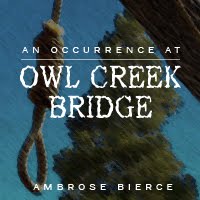
An Occurrence at Owl Creek Bridge
by Ambrose Bierce
________________________________________
A man stood upon a railroad bridge in northern Alabama, looking down into the swift water twenty feet below. The man's hands were behind his back, the wrists bound with a cord. A rope closely encircled his neck. It was attached to a stout cross-timber above his head and the slack fell to the level of his knees. Some loose boards laid upon the sleepers supporting the metals of the railway supplied a footing for him and his executioners--two private soldiers of the Federal army, directed by a sergeant who in civil life may have been a deputy sheriff. At a short remove upon the same temporary platform was an officer in the uniform of his rank, armed. He was a captain. A sentinel at each end of the bridge stood with his rifle in the position known as "support," that is to say, vertical in front of the left shoulder, the hammer resting on the forearm thrown straight across the chest--a formal and unnatural position, enforcing an erect carriage of the body. It did not appear to be the duty of these two men to know what was occurring at the center of the bridge; they merely blockaded the two ends of the foot planking that traversed it.
Beyond one of the sentinels nobody was in sight; the railroad ran straight away into a forest for a hundred yards, then, curving, was lost to view. Doubtless there was an outpost farther along. The other bank of the stream was open ground--a gentle acclivity topped with a stockade of vertical tree trunks, loopholed for rifles, with a single embrasure through which protruded the muzzle of a brass cannon commanding the bridge. Midway of the slope between the bridge and fort were the spectators--a single company of infantry in line, at "parade rest," the butts of the rifles on the ground, the barrels inclining slightly backward against the right shoulder, the hands crossed upon the stock. A lieu tenant stood at the right of the line, the point of his sword upon the ground, his left hand resting upon his right. Excepting the group of four at the center of the bridge, not a man moved. The company faced the bridge, staring stonily, motionless. The sentinels, facing the banks of the stream, might have been statues to adorn the bridge. The captain stood with folded arms, silent, observing the work of his subordinates, but making no sign. Death is a dignitary who when he comes announced is to be received with formal manifestations of respect, even by those most familiar with him. In the code of military etiquette silence and fixity are forms of deference.
The man who was engaged in being hanged was apparently about thirty-five years of age. He was a civilian, if one might judge from his habit, which was that of a planter. His features were good--a straight nose, firm mouth, broad forehead, from which his long, dark hair was combed straight back, falling behind his ears to the collar of his well-fitting frock coat. He wore a mustache and pointed beard, but no whiskers; his eyes were large and dark gray, and had a kindly expression which one would hardly have expected in one whose neck was in the hemp. Evidently this was no vulgar assassin. The liberal military code makes provision for hanging many kinds of persons, and gentlemen are not excluded.
The preparations being complete, the two private soldiers stepped aside and each drew away the plank upon which he had been standing. The sergeant turned to the captain, saluted and placed himself immediately behind that officer, who in turn moved apart one pace. These movements left the condemned man and the sergeant standing on the two ends of the same plank, which spanned three of the cross-ties of the bridge. The end upon which the civilian stood almost, but not quite, reached a fourth. This plank had been held in place by the weight of the captain; it was now held by that of the sergeant. At a signal from the former the latter would step aside, the plank would tilt and the condemned man go down between two ties. The arrangement commended itself to his judgment as simple and effective. His face had not been covered nor his eyes bandaged. He looked a moment at his "unsteadfast footing," then let his gaze wander to the swirling water of the stream racing madly beneath his feet. A piece of dancing driftwood caught his attention and his eyes followed it down the current. How slowly it appeared to move, What a sluggish stream!
He closed his eyes in order to fix his last thoughts upon his wife and children. The water, touched to gold by the early sun, the brooding mists under the banks at some distance down the stream, the fort, the soldiers, the piece of drift--all had distracted him. And now he became conscious of a new disturbance. Striking through the thought of his dear ones was a sound which he could neither ignore nor understand, a sharp, distinct, metallic percussion like the stroke of a blacksmith's hammer upon the anvil; it had the same ringing quality. He wondered what it was, and whether immeasurably distant or near by--it seemed both. Its recurrence was regular, but as slow as the tolling of a death knell. He awaited each stroke with impatience and--he knew not why--apprehension. The intervals of silence grew progressively longer, the delays became maddening. With their greater infrequency the sounds increased in strength and sharpness. They hurt his ear like the thrust of a knife; he feared he would shriek. What he heard was the ticking of his watch.
He unclosed his eyes and saw again the water below him. "If I could free my hands," he thought, "I might throw off the noose and spring into the stream. By diving I could evade the bullets and, swimming vigorously, reach the bank, take to the woods and get away home. My home, thank God, is as yet outside their lines; my wife and little ones are still beyond the invader's farthest advance."
As these thoughts, which have here to be set down in words, were flashed into the doomed man's brain rather than evolved from it the captain nodded to the sergeant. The sergeant stepped aside.

II
Peyton Farquhar was a well-to-do planter, of an old and highly respected Alabama family. Being a slave owner and like other slave owners a politician he was naturally an original secessionist and ardently devoted to the Southern cause. Circumstances of an imperious nature, which it is unnecessary to relate here, had prevented him from taking service with the gallant army that had fought the disastrous campaigns ending with the fall of Corinth, and he chafed under the inglorious restraint, longing for the release of his energies, the larger life of the soldier, the opportunity for distinction. That opportunity, he felt, would come, as it comes to all in war time. Meanwhile he did what he could. No service was too humble for him to perform in aid of the South, no adventure too perilous for him to undertake if consistent with the character of a civilian who was at heart a soldier, and who in good faith and without too much qualification assented to at least a part of the frankly villainous dictum that all is fair in love and war.
One evening while Farquhar and his wife were sitting on a rustic bench near the entrance to his grounds, a gray-clad soldier rode up to the gate and asked for a drink of water. Mrs. Farquhar was only toe, happy to serve him with her own white hands. While she was fetching the water her husband approached the dusty horseman and inquired eagerly for news from the front.
"The Yanks are repairing the railroads," said the man, "and are getting ready for another advance. They have reached the Owl Creek bridge, put it in order and built a stockade on the north bank. The commandant has issued an order, which is posted everywhere, declaring that any civilian caught interfering with the railroad, its bridges, tunnels or trains will be summarily hanged. I saw the order."
"How far is it to the Owl Creek bridge?" Farquhar asked.
"About thirty miles."
"Is there no force on this side the creek?"
"Only a picket post half a mile out, on the railroad, and a single sentinel at this end of the bridge."
"Suppose a man--a civilian and student of hanging--should elude the picket post and perhaps get the better of the sentinel," said Farquhar, smiling, "what could he accomplish?"
The soldier reflected. "I was there a month ago," he replied. "I observed that the flood of last winter had lodged a great quantity of driftwood against the wooden pier at this end of the bridge. It is now dry and would burn like tow."
The lady had now brought the water, which the soldier drank. He thanked her ceremoniously, bowed to her husband and rode away. An hour later, after nightfall, he repassed the plantation, going northward in the direction from which he had come. He was a Federal scout.

III
As Peyton Farquhar fell straight downward through the bridge he lost consciousness and was as one already dead. From this state he was awakened--ages later, it seemed to him--by the pain of a sharp pressure upon his throat, followed by a sense of suffocation. Keen, poignant agonies seemed to shoot from his neck downward through every fiber of his body and limbs. These pains appeared to flash along well-defined lines of ramification and to beat with an inconceivably rapid periodicity. They seemed like streams of pulsating fire heating him to an intolerable temperature. As to his head, he was conscious of nothing but a feeling of fulness--of congestion. These sensations were unaccompanied by thought. The intellectual part of his nature was already effaced; he had power only to feel, and feeling was torment. He was conscious of motion. Encompassed in a luminous cloud, of which he was now merely the fiery heart, without material substance, he swung through unthinkable arcs of oscillation, like a vast pendulum. Then all at once, with terrible suddenness, the light about him shot upward with the noise of a loud splash; a frightful roaring was in his ears, and all was cold and dark. The power of thought was restored; he knew that the rope had broken and he had fallen into the stream. There was no additional strangulation; the noose about his neck was already suffocating him and kept the water from his lungs. To die of hanging at the bottom of a river!--the idea seemed to him ludicrous. He opened his eyes in the darkness and saw above him a gleam of light, but how distant, how inaccessible! He was still sinking, for the light became fainter and fainter until it was a mere glimmer. Then it began to grow and brighten, and he knew that he was rising toward the surface--knew it with reluctance, for he was now very comfortable. "To be hanged and drowned," he thought? "that is not so bad; but I do not wish to be shot. No; I will not be shot; that is not fair."
He was not conscious of an effort, but a sharp pain in his wrist apprised him that he was trying to free his hands. He gave the struggle his attention, as an idler might observe the feat of a juggler, without interest in the outcome. What splendid effort!--what magnificent, what superhuman strength! Ah, that was a fine endeavor! Bravo! The cord fell away; his arms parted and floated upward, the hands dimly seen on each side in the growing light. He watched them with a new interest as first one and then the other pounced upon the noose at his neck. They tore it away and thrust it fiercely aside, its undulations resembling those of a water snake. "Put it back, put it back!" He thought he shouted these words to his hands, for the undoing of the noose had been succeeded by the direst pang that he had yet experienced. His neck ached horribly; his brain was on fire; his heart, which had been fluttering faintly, gave a great leap, trying to force itself out at his mouth. His whole body was racked and wrenched with an insupportable anguish! But his disobedient hands gave no heed to the command. They beat the water vigorously with quick, downward strokes, forcing him to the surface. He felt his head emerge; his eyes were blinded by the sunlight; his chest expanded convulsively, and with a supreme and crowning agony his lungs engulfed a great draught of air, which instantly he expelled in a shriek!
He was now in full possession of his physical senses. They were, indeed, preternaturally keen and alert. Something in the awful disturbance of his organic system had so exalted and refined them that they made record of things never before perceived. He felt the ripples upon his face and heard their separate sounds as they struck. He looked at the forest on the bank of the stream, saw the individual trees, the leaves and the veining of each leaf--saw the very insects upon them: the locusts, the brilliant-bodied flies, the grey spiders stretching their webs from twig to twig. He noted the prismatic colors in all the dewdrops upon a million blades of grass. The humming of the gnats that danced above the eddies of the stream, the beating of the dragon flies' wings, the strokes of the water-spiders' legs, like oars which had lifted their boat--all these made audible music. A fish slid along beneath his eyes and he heard the rush of its body parting the water.
He had come to the surface facing down the stream; in a moment the visible world seemed to wheel slowly round, himself the pivotal point, and he saw the bridge, the fort, the soldiers upon the bridge, the captain, the sergeant, the two privates, his executioners. They were in silhouette against the blue sky. They shouted and gesticulated, pointing at him. The captain had drawn his pistol, but did not fire; the others were unarmed. Their movements were grotesque and horrible, their forms gigantic.
Suddenly he heard a sharp report and something struck the water smartly within a few inches of his head, spattering his face with spray. He heard a second report, and saw one of the sentinels with his rifle at his shoulder, a light cloud of blue smoke rising from the muzzle. The man in the water saw the eye of the man on the bridge gazing into his own through the sights of the rifle. He observed that it was a grey eye and remembered having read that grey eyes were keenest, and that all famous marksmen had them. Nevertheless, this one had missed.
A counter-swirl had caught Farquhar and turned him half round; he was again looking into the forest on the bank opposite the fort. The sound of a clear, high voice in a monotonous singsong now rang out behind him and came across the water with a distinctness that pierced and subdued all other sounds, even the beating of the ripples in his ears. Although no soldier, he had frequented camps enough to know the dread significance of that deliberate, drawling, aspirated chant; the lieu. tenant on shore was taking a part in the morning's work. How coldly and pitilessly--with what an even, calm intonation, presaging, and enforcing tranquillity in the men--with what accurately measured inter vals fell those cruel words:
"Attention, company! . . Shoulder arms! . . . Ready! . . . Aim! . . . Fire!"
Farquhar dived--dived as deeply as he could. The water roared in his ears like the voice of Niagara, yet he heard the dulled thunder of the volley and, rising again toward the surface, met shining bits of metal, singularly flattened, oscillating slowly downward. Some of them touched him on the face and hands, then fell away, continuing their descent. One lodged between his collar and neck; it was uncomfortably warm and he snatched it out.
As he rose to the surface, gasping for breath, he saw that he had been a long time under water; he was perceptibly farther down stream nearer to safety. The soldiers had almost finished reloading; the metal ramrods flashed all at once in the sunshine as they were drawn from the barrels, turned in the air, and thrust into their sockets. The two sentinels fired again, independently and ineffectually.
The hunted man saw all this over his shoulder; he was now swimming vigorously with the current. His brain was as energetic as his arms and legs; he thought with the rapidity of lightning.
The officer," he reasoned, "will not make that martinet's error a second time. It is as easy to dodge a volley as a single shot. He has probably already given the command to fire at will. God help me, I cannot dodge them all!"
An appalling plash within two yards of him was followed by a loud, rushing sound, diminuendo, which seemed to travel back through the air to the fort and died in an explosion which stirred the very river to its deeps!
A rising sheet of water curved over him, fell down upon him, blinded him, strangled him! The cannon had taken a hand in the game. As he shook his head free from the commotion of the smitten water he heard the deflected shot humming through the air ahead, and in an instant it was cracking and smashing the branches in the forest beyond.
"They will not do that again," he thought; "the next time they will use a charge of grape. I must keep my eye upon the gun; the smoke will apprise me--the report arrives too late; it lags behind the missile. That is a good gun."
Suddenly he felt himself whirled round and round--spinning like a top. The water, the banks, the forests, the now distant bridge, fort and men--all were commingled and blurred. Objects were represented by their colors only; circular horizontal streaks of color--that was all he saw. He had been caught in a vortex and was being whirled on with a velocity of advance and gyration that made him giddy and sick. In a few moments he was flung upon the gravel at the foot of the left bank of the stream--the southern bank--and behind a projecting point which concealed him from his enemies. The sudden arrest of his motion, the abrasion of one of his hands on the gravel, restored him, and he wept with delight. He dug his fingers into the sand, threw it over himself in handfuls and audibly blessed it. It looked like diamonds, rubies, emeralds; he could think of nothing beautiful which it did not resemble. The trees upon the bank were giant garden plants; he noted a definite order in their arrangement, inhaled the fragrance of their blooms. A strange, roseate light shone through the spaces among their trunks and the wind made in their branches the music of Æolian harps. He had no wish to perfect his escape--was content to remain in that enchanting spot until retaken.
A whiz and rattle of grapeshot among the branches high above his head roused him from his dream. The baffled cannoneer had fired him a random farewell. He sprang to his feet, rushed up the sloping bank, and plunged into the forest.
All that day he traveled, laying his course by the rounding sun. The forest seemed interminable; nowhere did he discover a break in it, not even a woodman's road. He had not known that he lived in so wild a region. There was something uncanny in the revelation.
By nightfall he was fatigued, footsore, famishing. The thought of his wife and children urged him on. At last he found a road which led him in what he knew to be the right direction. It was as wide and straight as a city street, yet it seemed untraveled. No fields bordered it, no dwelling anywhere. Not so much as the barking of a dog suggested human habitation. The black bodies of the trees formed a straight wall on both sides, terminating on the horizon in a point, like a diagram in a lesson in perspective. Overhead, as he looked up through this rift in the wood, shone great garden stars looking unfamiliar and grouped in strange constellations. He was sure they were arranged in some order which had a secret and malign significance. The wood on either side was full of singular noises, among which--once, twice, and again--he distinctly heard whispers in an unknown tongue.
His neck was in pain and lifting his hand to it found it horribly swollen. He knew that it had a circle of black where the rope had bruised it. His eyes felt congested; he could no longer close them. His tongue was swollen with thirst; he relieved its fever by thrusting it forward from between his teeth into the cold air. How softly the turf had carpeted the untraveled avenue--he could no longer feel the roadway beneath his feet!
Doubtless, despite his suffering, he had fallen asleep while walking, for now he sees another scene--perhaps he has merely recovered from a delirium. He stands at the gate of his own home. All is as he left it, and all bright and beautiful in the morning sunshine. He must have traveled the entire night. As he pushes open the gate and passes up the wide white walk, he sees a flutter of female garments; his wife, looking fresh and cool and sweet, steps down from the veranda to meet him. At the bottom of the steps she stands waiting, with a smile of ineffable joy, an attitude of matchless grace and dignity. Ah, how beautiful she is! He springs forward with extended arms. As he is about to clasp her he feels a stunning blow upon the back of the neck; a blinding white light blazes all about him with a sound like the shock of a cannon--then all is darkness and silence!
Peyton Farquhar was dead; his body, with a broken neck, swung gently from side to side beneath the timbers of the Owl Creek bridge.
Accompanying questions for Occurence
1. “Death is a dignitary who when he comes announced is to be received with formal manifestations of respect, even by those most familiar with him. In the code of military etiquette silence and fixity are forms of deference.”

Why does Bierce choose to personify death?

2. “The liberal military code makes provision for hanging many kinds of persons, and gentlemen are not excluded.”

What is ironic about the “liberal” military code?

3 The condemned man “let his gaze wander to the swirling water of the stream racing madly beneath his feet. A piece of dancing driftwood caught his attention and his eyes followed it down the current. How slowly it appeared to move! What a sluggish stream!
He closed his eyes in order to fix his last thoughts upon his wife and children.”

What point of view is being used and why?

4. “The soldier reflected. “I was there a month ago,” he replied. “I observed that the flood of last winter had lodged a great quantity of driftwood against the wooden pier at this end of the bridge. T is now dry and would burn like tow. (note that tow is coarse, broken hemp fibers)

Why does the soldier give Fahrquhar this information?

5. “The lady had now brought the water which the soldier drank. He thanked her ceremoniously, bowed to her husband and rode away. An hour later, after nightfall, he repassed the plantation, going northward in the direction from which he had come. He was a Federal scout.

How does this event lend suspense to the story? What is the horrible irony of the hospitality given to the soldier?

6. “The hunted man saw all this over his shoulder; he was now swimming vigorously with the current. His brain was as energetic as his arms and legs; he thought with the rapidity of lightning.”
What hints are there that these events are occurring in his mind?

7. “The trees upon the bank were giant garden plants; he noted a definite order in their arrangement, inhaled the fragrance of their blooms. A strange, roseate light shone through the spaces among their trunks and the wind made in their branches the music of Aeolian harps. He had no wish to perfect his escape—was content to remain in that enchanting spot until retaken.”

How does Bierce’s description of the forest foreshadow the end of the story?

8. “His neck was in pain and lifting his hand to it he found it horribly swollen. He knew that it had a cirle of black where the rope had bruised it. His eyes felt congested; he could no longer close them. His tongue was swollen with thirst; he relieved its fever by thrusting it forward from between his teeth into the cold air. How softly the turf had carpeted the untraveled avenue—he could no longer feel the roadway beneath his feet!”

What is really happening here?

Tuesday, February 1, 2011

Wednesday 3 February: A Wagner Matinee


Below is a copy of the introductory material on realism, natuaralism and regionalism. Make sure you are very familiar with this. As well, find the copy of The Wagner Matinee by Willa Cather. YOU SHALL BE WRITING ON THIS IN CLASS ON THURSDAY, the expectation being you have read the material! If we have a snow day on Wednesday, you will have extra time to prepare :)


The Realist Movement

Realistic fiction remains popular today, althought it many seem strange that is was once controversial. Realistic writers saw themselves as being in revolt against Romanticism. Mark Twain wrote an amusing essay whose target was the Romantic writer James Fenimore Cooper. In The Deerslayer, Twain claimed Cooper “has scored 114 offenses against literary art out of a possible 115.” One of these offenses, according to Twain, is that “the personages of a tale shall confine themselves to possibilities and let miracles alone; or if they venture a miracle, the author must plausible set it forth to make it look as possible and reasonable.”
How did Realism originate? There had been Realistic writers in France for some time, notably Honore de Balzac, Stendhal and Gustave Flaubert. Although these writers and others had great influence, American Realism had roots in this country, in the experiences of war, on the frontier and in the cities. Science played a part as well. The objectivity of science struck many writers as a worthy goal for literature. Just as important, perhaps, was general feeling that Romanticism was wearing thin. Students still recited romantic poetry and read Romantic novels but many writers believed these works to be old-fashioned.
A Romantic was limited only by his or her imagination, but a Realist had to find meaning in the commonplace. To do this, the Realist had to be acutely observant and to lay bare to readers the hidden meanings behind familiar words and actions. On the other hand, Realistic writers could deal honestly with characters that a Romantic writer would either avoid or gloss over: factory workers, bosses, politicians, gunfighters. The emphasis did not always please the critics, however. One journalist wrote of Willa Cather’s stories: “If the writers of fiction who use western Nebraska as material would look up now and then and not keep their eyes and noses in the cattle yards, they might be more agreeable company.” Despite such complaints, Realism held sway, and it remains dominant the present day.

Naturalism

Some writers of the period went one step beyond Realism. Influenced by the French Novelist Emile Zola, a literary movement known as Naturalism developed. According to Zola, a writer must examine people and society objectively and, like a scientist, draw conclusions from what is observed. In line with this belief, Naturalistic writers view reality as the inescapable working out of natural forces. One’s destiny, they said, is decided by heredity and environment, physical drives and economic circumstances. Because they believe people have no control over events, Naturalistic writers tend to be pessimistic.
Only a few major American writers embraced Naturalism. Only a few major American writers embraced Naturalism. One who did was Stephen Crane. His first novel, Maggie, Girl of the Streets, published in 1893, is the earliest Naturalistic work by an American writer. Jack London’s To Build a Fire presents on of the occurring themes of Naturalism: many at the mercy of the brutal forces of nature.

Regionalism

The third significant literary movement that developed during the latter part of the nineteenth century was Regionalism. Through the use of regional dialect and vivid descriptions of the landscape, the Regionalist sought to capture the essence of life in the various different regions of the growing nation.
At its very best, Regional writing transcends the region and becomes part of the national literature. Various reasons have been given to explain the popularity of the local color movement. Perhaps it was the desire of people throughout the reunited nation to learn more about one another after the discord of the Civil War. Whatever its cause, the outpouring of local color was remarkable and included such authors as Mark Twain in his early short story The Notorious Jumping Frog of Calaveras County, the Louisiana writer Kate Chopin, who produced outstanding tales of Creole and Cajun life and Mary Wilkins Freeman, who wrote memorably of rural New England life.

Applicable class material:

Realism: (short story) An Occurrence at Owl Creek Bridge by Ambrose Bierce
A Wagner Matinee
The Story of an Hour

(non-fiction investigative report) How the Other Half Lives by Jacob Riis

Naturalism: (short novel) Maggie, Girl of the Streets by Stephen Crane

(short novel) Ethan Frome by Edith Wharton

Regionalism: (excerpt) Life on the Mississippi by Mark Twain
(poem collection) Spoon River Anthology- this will be an individual performance
piece.


A Wagner Matinee by Willa Cather

I received one morning a letter, written in pale ink on glassy, blue-lined notepaper, and bearing the postmark of a little Nebraska village. This communication, worn and rubbed, looking as though it had been carried for some days in a coat pocket that was none too clean, was from my Uncle Howard and informed me that his wife had been left a small legacy by a bachelor relative who had recently died, and that it would be necessary for her to go to Boston to attend to the settling of the estate. He requested me to meet her at the station and render her whatever services might be necessary. On examining the date indicated as that of her arrival I found it no later than tomorrow. He had characteristically delayed writing until, had I been away from home for a day, I must have missed the good woman altogether.

The name of my Aunt Georgiana called up not alone her own figure, at once pathetic and grotesque, but opened before my feet a gulf of recollection so wide and deep that, as the letter dropped from my hand, I felt suddenly a stranger to all the present conditions of my existence, wholly ill at ease and out of place amid the familiar surroundings of my study. I became, in short, the gangling farm boy my aunt had known, scourged with chilblains and bashfulness, my hands cracked and sore from the corn husking. I felt the knuckles of my thumb tentatively, as though they were raw again. I sat again before her parlor organ, fumbling the scales with my stiff, red hands, while she, beside me, made canvas mittens for the huskers.

The next morning, after preparing my landlady somewhat, I set out for the station. When the train arrived I had some difficulty in finding my aunt. She was the last of the passengers to alight, and it was not until I got her into the carriage that she seemed really to recognize me. She had come all the way in a day coach; her linen duster had become black with soot, and her black bonnet gray with dust, during the journey. When we arrived at my boardinghouse the landlady put her to bed at once and I did not see her again until the next morning.

Whatever shock Mrs. Springer experienced at my aunt's appearance she considerately concealed. As for myself, I saw my aunt's misshapen figure with that feeling of awe and respect with which we behold explorers who have left their ears and fingers north of Franz Josef Land, or their health somewhere along the Upper Congo. My Aunt Georgiana had been a music teacher at the Boston Conservatory, somewhere back in the latter sixties. One summer, while visiting in the little village among the Green Mountains where her ancestors had dwelt for generations, she had kindled the callow fancy of the most idle and shiftless of all the village lads, and had conceived for this Howard Carpenter one of those extravagant passions which a handsome country boy of twenty-one sometimes inspires in an angular, spectacled woman of thirty. When she returned to her duties in Boston, Howard followed her, and the upshot of this inexplicable infatuation was that she eloped with him, eluding the reproaches of her family and the criticisms of her friends by going with him to the Nebraska frontier. Carpenter, who, of course, had no money, had taken a homestead in Red Willow County, fifty miles from the railroad. There they had measured off their quarter section themselves by driving across the prairie in a wagon, to the wheel of which they had tied a red cotton handkerchief, and counting off its revolutions. They built a dugout in the red hillside, one of those cave dwellings whose inmates so often reverted to primitive conditions. Their water they got from the lagoons where the buffalo drank, and their slender stock of provisions was always at the mercy of bands of roving Indians. For thirty years my aunt had not been further than fifty miles from the homestead.

But Mrs. Springer knew nothing of all this, and must have been considerably shocked at what was left of my kinswoman. Beneath the soiled linen duster which, on her arrival, was the most conspicuous feature of her costume, she wore a black stuff dress, whose ornamentation showed that she had surrendered herself unquestioningly into the hands of a country dressmaker. My poor aunt's figure, however, would have presented astonishing difficulties to any dressmaker. Originally stooped, her shoulders were now almost bent together over her sunken chest. She wore no stays, and her gown, which trailed unevenly behind, rose in a sort of peak over her abdomen. She wore ill-fitting false teeth, and her skin was as yellow as a Mongolian's from constant exposure to a pitiless wind and to the alkaline water which hardens the most transparent cuticle into a sort of flexible leather.

I owed to this woman most of the good that ever came my way in my boyhood, and had a reverential affection for her. During the years when I was riding herd for my uncle, my aunt, after cooking the three meals--the first of which was ready at six o'clock in the morning-and putting the six children to bed, would often stand until midnight at her ironing board, with me at the kitchen table beside her, hearing me recite Latin declensions and conjugations, gently shaking me when my drowsy head sank down over a page of irregular verbs. It was to her, at her ironing or mending, that I read my first Shakespeare', and her old textbook on mythology was the first that ever came into my empty hands. She taught me my scales and exercises, too--on the little parlor organ, which her husband had bought her after fifteen years, during which she had not so much as seen any instrument, but an accordion that belonged to one of the Norwegian farmhands. She would sit beside me by the hour, darning and counting while I struggled with the "Joyous Farmer," but she seldom talked to me about music, and I understood why. She was a pious woman; she had the consolations of religion and, to her at least, her martyrdom was not wholly sordid. Once when I had been doggedly beating out some easy passages from an old score of Euryanthe I had found among her music books, she came up to me and, putting her hands over my eyes, gently drew my head back upon her shoulder, saying tremulously, "Don't love it so well, Clark, or it may be taken from you. Oh, dear boy, pray that whatever your sacrifice may be, it be not that."

When my aunt appeared on the morning after her arrival she was still in a semi-somnambulant state. She seemed not to realize that she was in the city where she had spent her youth, the place longed for hungrily half a lifetime. She had been so wretchedly train-sick throughout the journey that she bad no recollection of anything but her discomfort, and, to all intents and purposes, there were but a few hours of nightmare between the farm in Red Willow County and my study on Newbury Street. I had planned a little pleasure for her that afternoon, to repay her for some of the glorious moments she had given me when we used to milk together in the straw-thatched cowshed and she, because I was more than usually tired, or because her husband had spoken sharply to me, would tell me of the splendid performance of the Huguenots she had seen in Paris, in her youth. At two o'clock the Symphony Orchestra was to give a Wagner program, and I intended to take my aunt; though, as I conversed with her I grew doubtful about her enjoyment of it. Indeed, for her own sake, I could only wish her taste for such things quite dead, and the long struggle mercifully ended at last. I suggested our visiting the Conservatory and the Common before lunch, but she seemed altogether too timid to wish to venture out. She questioned me absently about various changes in the city, but she was chiefly concerned that she had forgotten to leave instructions about feeding half-skimmed milk to a certain weakling calf, "old Maggie's calf, you know, Clark," she explained, evidently having forgotten how long I had been away. She was further troubled because she had neglected to tell her daughter about the freshly opened kit of mackerel in the cellar, which would spoil if it were not used directly.

I asked her whether she had ever heard any of the Wagnerian operas and found that she had not, though she was perfectly familiar with their respective situations, and had once possessed the piano score of The Flying Dutchman. I began to think it would have been best to get her back to Red Willow County without waking her, and regretted having suggested the concert.

From the time we entered the concert hall, however, she was a trifle less passive and inert, and for the first time seemed to perceive her surroundings. I had felt some trepidation lest she might become aware of the absurdities of her attire, or might experience some painful embarrassment at stepping suddenly into the world to which she had been dead for a quarter of a century. But, again, I found how superficially I had judged her. She sat looking about her with eyes as impersonal, almost as stony, as those with which the granite Rameses in a museum watches the froth and fret that ebbs and flows about his pedestal-separated from it by the lonely stretch of centuries. I have seen this same aloofness in old miners who drift into the Brown Hotel at Denver, their pockets full of bullion, their linen soiled, their haggard faces unshaven; standing in the thronged corridors as solitary as though they were still in a frozen camp on the Yukon, conscious that certain experiences have isolated them from their fellows by a gulf no haberdasher could bridge.

We sat at the extreme left of the first balcony, facing the arc of our own and the balcony above us, veritable hanging gardens, brilliant as tulip beds. The matinee audience was made up chiefly of women. One lost the contour of faces and figures-- indeed, any effect of line whatever-and there was only the color of bodices past counting, the shimmer of fabrics soft and firm, silky and sheer: red, mauve, pink, blue, lilac, purple, ecru, rose, yellow, cream, and white, all the colors that an impressionist finds in a sunlit landscape, with here and there the dead shadow of a frock coat. My Aunt Georgiana regarded them as though they had been so many daubs of tube-paint on a palette.

When the musicians came out and took their places, she gave a little stir of anticipation and looked with quickening interest down over the rail at that invariable grouping, perhaps the first wholly familiar thing that had greeted her eye since she had left old Maggie and her weakling calf. I could feel how all those details sank into her soul, for I had not forgotten how they had sunk into mine when. I came fresh from plowing forever and forever between green aisles of corn, where, as in a treadmill, one might walk from daybreak to dusk without perceiving a shadow of change. The clean profiles of the musicians, the gloss of their linen, the dull black of their coats, the beloved shapes of the instruments, the patches of yellow light thrown by the green- shaded lamps on the smooth, varnished bellies of the cellos and the bass viols in the rear, the restless, wind-tossed forest of fiddle necks and bows-I recalled how, in the first orchestra I had ever heard, those long bow strokes seemed to draw the heart out of me, as a conjurer's stick reels out yards of paper ribbon from a hat.

The first number was the Tannhauser overture. When the horns drew out the first strain of the Pilgrim's chorus my Aunt Georgiana clutched my coat sleeve. Then it was I first realized that for her this broke a silence of thirty years; the inconceivable silence of the plains. With the battle between the two motives, with the frenzy of the Venusberg theme and its ripping of strings, there came to me an overwhelming sense of the waste and wear we are so powerless to combat; and I saw again the tall, naked house on the prairie, black and grim as a wooden fortress; the black pond where I had learned to swim, its margin pitted with sun-dried cattle tracks; the rain-gullied clay banks about the naked house, the four dwarf ash seedlings where the dishcloths were always hung to dry before the kitchen door. The world there was the flat world of the ancients; to the east, a cornfield that stretched to daybreak; to the west, a corral that reached to sunset; between, the conquests of peace, dearer bought than those of war.

The overture closed; my aunt released my coat sleeve, but she said nothing. She sat staring at the orchestra through a dullness of thirty years, through the films made little by little by each of the three hundred and sixty-five days in every one of them. What, I wondered, did she get from it? She had been a good pianist in her day I knew, and her musical education had been broader than that of most music teachers of a quarter of a century ago. She had often told me of Mozart's operas and Meyerbeer's, and I could remember hearing her sing, years ago, certain melodies of Verdi's. When I had fallen ill with a fever in her house she used to sit by my cot in the evening--when the cool, night wind blew in through the faded mosquito netting tacked over the window, and I lay watching a certain bright star that burned red above the cornfield--and sing "Home to our mountains, O, let us return!" in a way fit to break the heart of a Vermont boy near dead of homesickness already.

I watched her closely through the prelude to Tristan and Isolde, trying vainly to conjecture what that seething turmoil of strings and winds might mean to her, but she sat mutely staring at the violin bows that drove obliquely downward, like the pelting streaks of rain in a summer shower. Had this music any message for her? Had she enough left to at all comprehend this power which had kindled the world since she had left it? I was in a fever of curiosity, but Aunt Georgiana sat silent upon her peak in Darien. She preserved this utter immobility throughout the number from The Flying Dutchman, though her fingers worked mechanically upon her black dress, as though, of themselves, they were recalling the piano score they had once played. Poor old hands! They had been stretched and twisted into mere tentacles to hold and lift and knead with; the palms unduly swollen, the fingers bent and knotted--on one of them a thin, worn band that had once been a wedding ring. As I pressed and gently quieted one of those groping hands I remembered with quivering eyelids their services for me in other days.

Soon after the tenor began the "Prize Song," I heard a quick drawn breath and turned to my aunt. Her eyes were closed, but the tears were glistening on her cheeks, and I think, in a moment more, they were in my eyes as well. It never really died, then-- the soul that can suffer so excruciatingly and so interminably; it withers to the outward eye only; like that strange moss which can lie on a dusty shelf half a century and yet, if placed in water, grows green again. She wept so throughout the development and elaboration of the melody.

During the intermission before the second half of the concert, I questioned my aunt and found that the "Prize Song" was not new to her. Some years before there had drifted to the farm in Red Willow County a young German, a tramp cowpuncher, who had sung the chorus at Bayreuth, when he was a boy, along with the other peasant boys and girls. Of a Sunday morning he used to sit on his gingham-sheeted bed in the hands' bedroom which opened off the kitchen, cleaning the leather of his boots and saddle, singing the "Prize Song," while my aunt went about her work in the kitchen. She had hovered about him until she had prevailed upon him to join the country church, though his sole fitness for this step, insofar as I could gather, lay in his boyish face and his possession of this divine melody. Shortly afterward he had gone to town on the Fourth of July, been drunk for several days, lost his money at a faro table, ridden a saddled Texan steer on a bet, and disappeared with a fractured collarbone. All this my aunt told me huskily, wanderingly, as though she were talking in the weak lapses of illness.

"Well, we have come to better things than the old Trovatore at any rate, Aunt Georgie?" I queried, with a well-meant effort at jocularity.

Her lip quivered and she hastily put her handkerchief up to her mouth. From behind it she murmured, "And you have been hearing this ever since you left me, Clark?" Her question was the gentlest and saddest of reproaches.

The second half of the program consisted of four numbers from the Ring, and closed with Siegfried's funeral march. My aunt wept quietly, but almost continuously, as a shallow vessel overflows in a rainstorm. From time to time her dim eyes looked up at the lights which studded the ceiling, burning softly under their dull glass globes; doubtless they were stars in truth to her. I was still perplexed as to what measure of musical comprehension was left to her, she who had heard nothing but the singing of gospel hymns at Methodist services in the square frame schoolhouse on Section Thirteen for so many years. I was wholly unable to gauge how much of it had been dissolved in soapsuds, or worked into bread, or milked into the bottom of a pail.

The deluge of sound poured on and on; I never knew what she found in the shining current of it; I never knew how far it bore her, or past what happy islands. From the trembling of her face I could well believe that before the last numbers she had been carried out where the myriad graves are, into the gray, nameless burying grounds of the sea; or into some world of death vaster yet, where, from the beginning of the world, hope has lain down with hope and dream with dream and, renouncing, slept.

The concert was over; the people filed out of the hall chattering and laughing, glad to relax and find the living level again, but my kinswoman made no effort to rise. The harpist slipped its green felt cover over his instrument; the flute players shook the water from their mouthpieces; the men of the orchestra went out one by one, leaving the stage to the chairs and music stands, empty as a winter cornfield.

I spoke to my aunt. She burst into tears and sobbed pleadingly. "I don't want to go, Clark, I don't want to go!"

I understood. For her, just outside the door of the concert hall, lay the black pond with the cattle-tracked bluffs; the tall, unpainted house, with weather-curled boards; naked as a tower, the crook-backed ash seedlings where the dishcloths hung to dry; the gaunt, molting turkeys picking up refuse about the kitchen door.